


PLAN B (B for Brexit)

Descendants of Sephardic Jews and European citizenship opportunity
Introduction
Sephardic Jews are the descendants of the ancient Jewish communities of the Iberian Peninsula. Worldwide there are about 3.5 million Sephardic descendants of Portuguese and Spanish origin. The Portuguese State recently recognised that the persecution and expulsion of Jews, during the 15th and 16th centuries, was an injustice and an historical error. Now, new legislation has been ratified, offering Portuguese nationality to all descendants of Portuguese Sephardic Jews.
Background History
Thousands of Spanish Jews settled in Portugal and joined the Sephardic communities after the expulsion ordered by the Catholic Monarchs in 1492.
Persecuted by the Spanish Inquisition, they took refuge in Portugal, but were later driven out during the reign of King Manuel in 1496, due to his marriage to Isabella of Aragon, the Spanish heir. There are historical records of persecutions, executions and expulsions of Jews who did not choose to convert to Christianity and become new Christians. Those that escaped settled in Turkey, the Netherlands, United Kingdom and several countries in North Africa. Portuguese surnames can still be found in these areas.
The law
In February 2015 the Portuguese government finally ratified a new piece of legislation amending the country’s Nationality Law, which states that “the Government may grant citizenship by naturalization (…) to the descendants of Portuguese Sephardic Jews, who are able to objectively demonstrate a traditional connection to a Sephardic community of Portuguese origin, through for example a Portuguese surname, language, or a proven direct or collateral descent”.
The possibility of granting Portuguese citizenship to Sephardic Jews, who can prove they are of Portuguese descent, has been planned since 2013, based on a proposed amendment to the 1981 Nationality Law. However, only in the last year has this become a reality, with the final ratification, in February 2015, of the new legislation regulating this aspect of the Nationality Law. The Spanish government is also granting Spanish nationality to Sephardic Jews of Spanish descent, but unlike in Spain, the Portuguese law does not impose any time constraints for applications.
Furthermore, it is of interest to note that applicants are not required to have lived in Portugal for any period of time, nor do they need to have any previous knowledge of the Portuguese language.
The Opportunity
According to the latest Global Peace Index report, the world has become slightly less peaceful in 2016. Portugal was considered the fifth most peaceful country in the world, having risen nine positions in the table when compared with the previous report.
Compared with the previous year, Europe was the region that suffered the most acts of terrorism, with Turkey, France and Belgium among the most affected, but nevertheless, Europe continues to have six of the seven safest countries in the global rankings.
Security is undoubtedly a major factor for any family who is choosing a new country to live in, but in Europe there are other advantages including the economy, education and health, among others. Acquiring the nationality of a member country of the European Union is undoubtedly an intelligent move.
Citizens from a variety of countries, mostly from outside the EU (Turkey, Israel, Brazil or the United States of America) are ceasing the opportunity to become citizens of the European Union, and in 2015 Portugal saw an enormous increase in nationality requests.
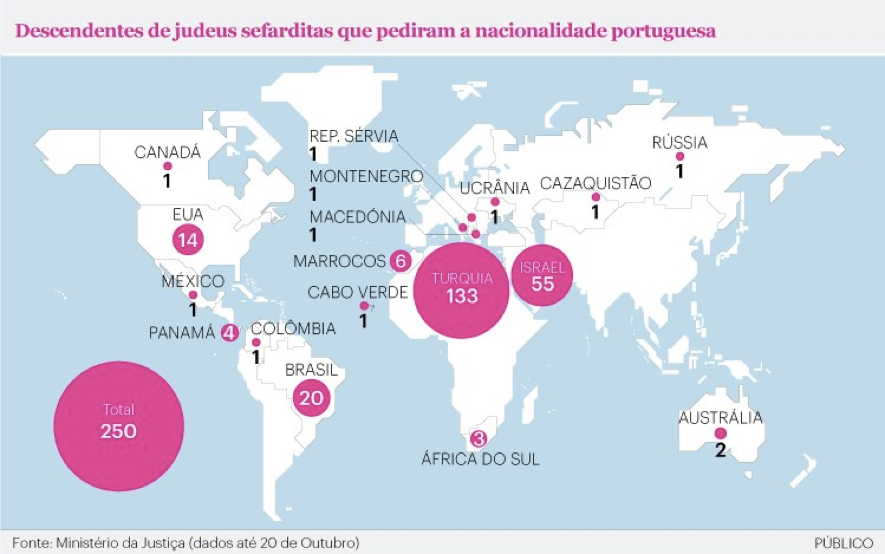
Graph illustrates the numbers of descendants of Sephardic Jews, outside the EU, requesting Portuguese nationality in 2015
Brexit
Some Sephardic families settled in London during the sixteenth and seventeenth centuries and others immigrated to Britain in the twentieth century after passing through North Africa and the Middle East.
Since the results of Brexit were announced, following the referendum in the UK on the 23rd of June, approximately 400 British citizens, descendants of Portuguese Sephardic Jews, have requested Portuguese nationality under this recent legislation, compared to only five requests in 2015. The number of applicants is expected to rise, as Britain prepares to exit the European Union.
The advantages are obvious: as with any citizen from a EU member country, Portuguese citizens have the right to travel, work and live freely in the EU country of their choice, without the need for any complicated visa applications, which are mandatory for non-EU citizens. British citizens are likely to lose this right.
Required documents
The application must be accompanied by the following documents:
- Birth Certificate.
- Authenticated certificate of criminal record issued by the competent authorities of the country of birth and nationality, as well as from any countries where the person may have lived in the past.
- Certificate issued by an official Portuguese based Jewish community attesting the applicant’s connection to a Sephardic Jewish community of Portuguese origin.
This Newsletter concerning the processing of personal data and the protection of privacy in the electronic communications sector (Directive on privacy and electronic communications) according with DIRECTIVE 2002/58/EC OF THE EUROPEAN PARLIAMENT AND OF THE COUNCIL of 12 July 2002
Contacts :
GETiN- Relocation Services, Praça da Armada, 35-1º 1350-027 Lisboa Portugal
